
jeep wrangler instruction manual
This manual provides comprehensive guidance for Jeep Wrangler owners, covering operation, maintenance, and troubleshooting. Resources like autoinfo24.ru and krutilvertel.com offer repair manuals, aiding in vehicle upkeep and repair procedures.
Detailed guides, including those for models from 2006-2010, are available, ensuring owners have access to crucial information for their specific Wrangler.
Understanding Your Wrangler: A Comprehensive Guide
This guide serves as an essential resource for all Jeep Wrangler owners, offering detailed insights into the vehicle’s intricacies. Manuals from sources like autoinfo24.ru and krutilvertel.com provide crucial repair and operational information, specifically covering models from 2006 onwards.
Owners will discover detailed explanations of components, maintenance schedules, and troubleshooting procedures. Understanding the Wrangler’s systems – from the engine to the four-wheel drive – is paramount for safe and efficient operation. These resources empower owners to confidently maintain and repair their vehicle, ensuring longevity and performance.
Vehicle Identification & Key Components
Locate your Vehicle Identification Number (VIN) and familiarize yourself with the engine compartment. Refer to the instruction manual for component locations and functions.
Understanding these elements is crucial for maintenance, repairs, and accurate parts identification.
Vehicle Identification Number (VIN) Location
The Vehicle Identification Number (VIN) is a unique 17-character code essential for identifying your specific Jeep Wrangler. Locating this number is crucial for warranty claims, registration, and theft recovery. Typically, you can find the VIN in several places on your vehicle.
Look on the driver’s side dashboard, visible through the windshield. Additionally, it’s often stamped on the driver’s side doorjamb, on the vehicle’s title, and registration documents. Consult your Jeep Wrangler instruction manual for the precise location specific to your model year, as placement can vary slightly.
Engine Compartment Overview
The engine compartment of your Jeep Wrangler houses vital components requiring periodic inspection. Key elements include the engine itself, coolant reservoir, brake fluid reservoir, power steering fluid reservoir, and the battery. Locate the air filter housing for easy access during maintenance.
Familiarize yourself with the fuse box location, typically found under the hood. Refer to your owner’s manual for detailed diagrams identifying each component. Regularly check fluid levels and inspect hoses for leaks or damage, ensuring optimal engine performance and longevity.
Understanding Dashboard Symbols and Indicators
Your Jeep Wrangler’s dashboard features various symbols and indicators providing crucial vehicle information. The check engine light signals potential engine issues, requiring diagnosis. The ABS light indicates a problem with the anti-lock braking system. Pay attention to the battery warning light, signifying charging system concerns.
Familiarize yourself with symbols for oil pressure, coolant temperature, and fuel level. Understanding these indicators allows for prompt attention to potential problems, ensuring safe and reliable operation of your Wrangler. Consult your owner’s manual for a complete explanation of each symbol.

Operating Your Jeep Wrangler
Mastering your Wrangler involves understanding starting/stopping procedures, transmission operation, and the four-wheel drive system. Proper use ensures optimal performance and safety during all driving conditions.
Starting and Stopping the Engine
Before starting, ensure the parking brake is engaged and the transmission is in Park or Neutral. Insert the key into the ignition and turn it to the ‘Start’ position, releasing once the engine ignites. Avoid prolonged cranking to prevent starter damage.
To stop the engine, depress the brake pedal firmly and turn the key to the ‘Off’ position. Remove the key to prevent accidental operation; Always allow the engine to idle briefly before shutting it down, especially after heavy use, to ensure proper cooling and lubrication.
Refer to your specific model’s manual for any unique starting or stopping procedures, as variations may exist.
Transmission Operation (Manual & Automatic)
Manual transmissions require smooth clutch engagement and precise gear selection. Avoid riding the clutch, as this causes premature wear. Automatic transmissions offer convenient shifting; select ‘Drive’ for forward motion, ‘Reverse’ for backing up, and ‘Neutral’ when stopped for extended periods.
Utilize ‘Low’ range for steep inclines or off-road conditions, providing increased torque. Be mindful of transmission fluid levels, checking regularly for proper operation. Consult the owner’s manual for specific shifting recommendations and maintenance schedules.
Proper operation extends transmission life and ensures optimal performance.
Four-Wheel Drive System: Engagement and Disengagement
The Wrangler’s 4WD system enhances traction on challenging terrain. Engage 4-High for slippery roads like snow or gravel, and 4-Low for severe off-road conditions requiring maximum torque. Disengage 4WD on dry pavement to prevent drivetrain damage and optimize fuel efficiency.
Always ensure the vehicle is moving slowly when shifting into or out of 4WD. Consult your owner’s manual for specific instructions related to your Wrangler’s 4WD system configuration. Regularly inspect the transfer case fluid level for proper operation.
Safe and correct usage maximizes the system’s benefits.
Understanding the Electronic Stability Control (ESC) System
The Wrangler’s Electronic Stability Control (ESC) system helps maintain directional control during critical maneuvers, preventing skids. ESC monitors steering input and vehicle direction, automatically applying brakes to individual wheels as needed. A flashing ESC light indicates the system is actively working;
ESC is not a substitute for careful driving. Reduce speed and maintain a safe following distance, even with ESC engaged. The system has limitations on gravel or snow. Refer to your owner’s manual for detailed information and system operation.

Maintenance Schedule & Procedures
Regular maintenance, including oil changes, tire checks, and fluid level inspections, is crucial for Wrangler reliability. Follow the recommended schedule in your owner’s manual for optimal performance.
Recommended Oil Change Intervals
Maintaining proper oil levels and adhering to recommended change intervals are vital for your Jeep Wrangler’s engine longevity. Generally, for standard driving conditions, oil changes are suggested every 7,500 to 10,000 miles, or approximately every six months, whichever comes first.
However, severe driving conditions – such as frequent towing, off-roading, or stop-and-go traffic – necessitate more frequent oil changes, potentially every 3,000 to 5,000 miles. Always consult your specific Wrangler’s owner’s manual for the manufacturer’s precise recommendations, as intervals can vary based on engine type and model year. Using the correct oil viscosity is also critical for optimal engine protection.
Tire Maintenance: Pressure, Rotation, and Wear
Proper tire maintenance significantly impacts your Jeep Wrangler’s handling, safety, and fuel efficiency. Regularly check tire pressure – typically 30-35 PSI, but refer to the sticker on your driver’s side doorjamb for the exact specification. Tire rotation, every 5,000-8,000 miles, promotes even wear, extending tire life.
Inspect tires for uneven wear patterns, cuts, or bulges. Uneven wear can indicate alignment issues. Maintain adequate tread depth for optimal traction, especially when off-roading. Replace tires when tread depth reaches 2/32 of an inch, ensuring continued safety and performance.
Fluid Level Checks (Coolant, Brake Fluid, Power Steering Fluid)
Regularly checking fluid levels is crucial for maintaining your Jeep Wrangler’s optimal performance. Inspect the coolant reservoir when the engine is cold, ensuring the level is between the “Min” and “Max” marks. Check brake fluid in the master cylinder, noting any significant drops which could indicate a leak.
Power steering fluid should also be checked periodically, maintaining the level within the designated range. Low fluid levels can lead to system damage. Always use the recommended fluid types specified in your owner’s manual to avoid compatibility issues and ensure proper function.
Air Filter Replacement
Maintaining a clean air filter is vital for your Jeep Wrangler’s engine health and fuel efficiency. Inspect the air filter regularly for dirt and debris; replacement intervals vary based on driving conditions. A clogged filter restricts airflow, reducing performance.
To replace, locate the air filter housing, typically a black plastic box. Remove the cover, discard the old filter, and install a new one, ensuring a proper seal. Refer to your owner’s manual for specific instructions and recommended filter types for your Wrangler model.

Basic Troubleshooting
This section details solutions for common Wrangler issues like flat tires and jump-starting. Refer to the manual for battery maintenance and diagnostic code access procedures.
Dealing with a Flat Tire
Should you experience a flat tire on your Jeep Wrangler, safety is paramount. First, activate your hazard lights and pull over to a safe, level location away from traffic. Consult your owner’s manual for the precise location of the spare tire, jack, and lug wrench – typically found within the vehicle’s storage areas.
Carefully loosen the lug nuts on the flat tire before jacking up the vehicle. Position the jack correctly, as indicated in the manual, and raise the vehicle until the flat tire is clear of the ground. Remove the lug nuts completely, then pull the flat tire off the wheel studs. Mount the spare tire, tighten the lug nuts by hand, lower the vehicle, and fully tighten the lug nuts in a star pattern. Finally, check the spare tire’s pressure and have the flat tire repaired or replaced as soon as possible.
Jump Starting Your Wrangler
If your Jeep Wrangler’s battery is depleted, a jump start can get you going. Ensure both vehicles are turned off before connecting the jumper cables. Attach the red (positive) cable to the positive terminal of the dead battery, then to the positive terminal of the good battery. Connect the black (negative) cable to the negative terminal of the good battery, and then to a grounded metal surface on your Wrangler – not the negative terminal of the dead battery.
Start the vehicle with the good battery and let it run for a few minutes. Then, attempt to start your Wrangler. If successful, let it run for at least 20 minutes to recharge the battery. Disconnect the cables in the reverse order of connection. Consult your owner’s manual for specific guidance and safety precautions.
Battery Maintenance and Replacement
Regular battery maintenance extends its life and ensures reliable starting. Inspect the terminals for corrosion and clean them with a baking soda solution if necessary. Ensure the battery is securely mounted to prevent damage from vibration. Check the battery’s voltage periodically with a voltmeter; a healthy battery should read around 12.6 volts.
When replacement is needed, choose a battery with the correct group size and cold cranking amps (CCA) for your Wrangler. Disconnect the negative terminal first, then the positive. Properly dispose of the old battery at a recycling center. Consult your owner’s manual for specific battery specifications.
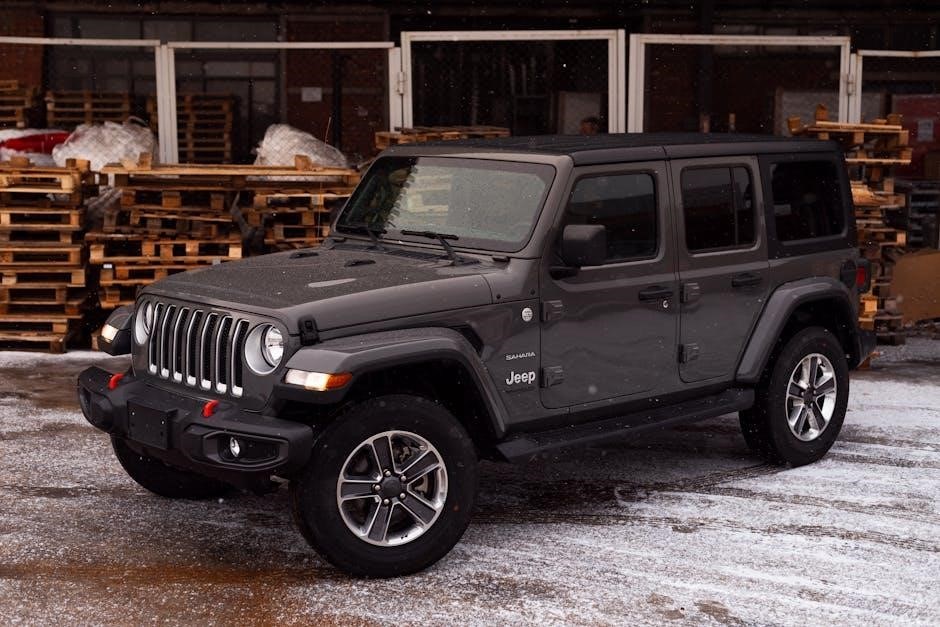
Safety Features & Systems
Your Wrangler incorporates crucial safety systems like airbags, seatbelts, and a robust brake system. Understanding their operation and proper maintenance is vital for occupant protection during operation.
Airbag System: Operation and Precautions
The Jeep Wrangler’s airbag system is a vital safety component designed to provide supplemental protection in the event of a collision. Airbags deploy rapidly, so always wear your seatbelt, as it’s designed to work with the airbag system.
Children should never be seated in the front passenger seat, especially if the airbag isn’t manually deactivated (if equipped). Improper seating or modifications to the airbag system can cause serious injury. Regular inspection of the system is recommended, and any warning lights should be addressed immediately by a qualified technician.
Be aware that airbags deploy with significant force and can cause abrasions. Always follow the manufacturer’s guidelines for safe operation and maintenance of this critical safety feature.
Seatbelt System: Proper Usage and Maintenance
The Jeep Wrangler’s seatbelt system is your primary safety restraint. Always ensure all occupants are properly secured with seatbelts before starting your journey. Seatbelts should fit snugly across the hips, not the stomach, and shoulder straps should lie flat against the chest.
Regularly inspect seatbelts for any signs of damage, such as fraying or tears. Do not use damaged seatbelts and replace them immediately. Avoid twisting or knotting seatbelts, as this compromises their effectiveness. Keep buckles clean and free of debris to ensure proper latching.
Remember, seatbelts are designed to work with the airbag system for optimal protection in a collision.
Brake System: Inspection and Maintenance
Your Jeep Wrangler’s brake system is critical for safe operation. Regularly inspect brake pads, rotors, and lines for wear and damage. Check brake fluid levels frequently and top off as needed, using the specified fluid type. Look for any leaks in the brake lines.
Listen for unusual noises, like squealing or grinding, during braking, which may indicate worn brake pads. Have the brake system professionally inspected at recommended intervals. Ensure proper brake function before each journey.
Promptly address any brake system issues to maintain optimal stopping power and safety.
Wrangler Specific Features
The Jeep Wrangler uniquely offers removable tops and doors, alongside a folding windshield. Understanding these features, alongside the suspension, enhances the Wrangler experience.
Removable Top and Doors: Operation and Storage
The Jeep Wrangler’s defining characteristic is its removable top and doors, offering an open-air driving experience. Proper operation involves understanding the latching mechanisms for both hard and soft tops, ensuring a secure fit. Carefully follow the instructions for removal to prevent damage to seals or the vehicle’s body.
Storage requires a clean, dry environment, away from direct sunlight to prevent fading or cracking. Dedicated storage racks or padded covers are recommended to protect the components. Always inspect the seals for wear and tear before re-installation, maintaining a weatherproof seal. Refer to the owner’s manual for specific model instructions.
Windshield Folding and Latch Operation
The Wrangler’s unique windshield folding feature enhances the open-air experience. Operation requires releasing the windshield latches, typically located at the base of the windshield frame. Ensure the parking brake is engaged and the vehicle is on a level surface before attempting to fold it down.
Carefully guide the windshield forward, ensuring no obstructions. Secure the windshield properly using the retaining strap to prevent accidental movement during driving. Inspect the latches regularly for proper function and lubrication. Refer to the owner’s manual for detailed instructions and safety precautions regarding this feature.
Understanding the Wrangler’s Suspension System
The Jeep Wrangler features a robust suspension designed for both on- and off-road capability. Key components include solid axles, coil springs, and shock absorbers, providing articulation and ride comfort. Different Wrangler trims may have variations in suspension tuning and components.
Regular inspection of suspension parts is crucial for safety and performance. Check for worn bushings, damaged shocks, and loose connections; Understanding the system allows for proper maintenance and upgrades to enhance handling and off-road prowess. Consult the owner’s manual for specific details about your Wrangler’s suspension.

Detailed System Overviews
This section delves into the Wrangler’s core systems – cooling, electrical, and fuel – providing in-depth explanations of components, functions, and maintenance procedures for optimal performance.
Cooling System: Components and Function
The Jeep Wrangler’s cooling system is vital for maintaining optimal engine temperature, preventing overheating, and ensuring longevity. Key components include the radiator, responsible for dissipating heat, the water pump, which circulates coolant, and the thermostat, regulating coolant flow.
Hoses and belts transport coolant and drive the water pump, while the cooling fan enhances airflow. Proper function relies on sufficient coolant levels and regular inspection for leaks or damage. Maintaining this system prevents costly engine repairs and ensures reliable performance, especially during demanding conditions.
Electrical System: Fuses, Relays, and Wiring Diagrams
The Jeep Wrangler’s electrical system powers all vehicle functions, from lights to the engine control unit. Fuses protect circuits from overloads, while relays act as switches for higher-current devices. Understanding wiring diagrams is crucial for diagnosing and repairing electrical issues.
Locating the fuse box and identifying specific fuse functions is essential. Repair manuals, like those found on autoinfo24.ru and krutilvertel.com, provide detailed diagrams. Proper maintenance involves inspecting for corrosion and replacing faulty components to ensure reliable operation.
Fuel System: Components and Maintenance
The Jeep Wrangler’s fuel system delivers fuel from the tank to the engine. Key components include the fuel pump, fuel filter, fuel lines, and fuel injectors. Regular maintenance is vital for optimal performance and preventing issues.
Routine checks should include inspecting fuel lines for leaks and replacing the fuel filter at recommended intervals. Repair manuals, available through resources like autoinfo24.ru and krutilvertel.com, detail component locations and procedures. Proper fuel system care ensures efficient engine operation and longevity.
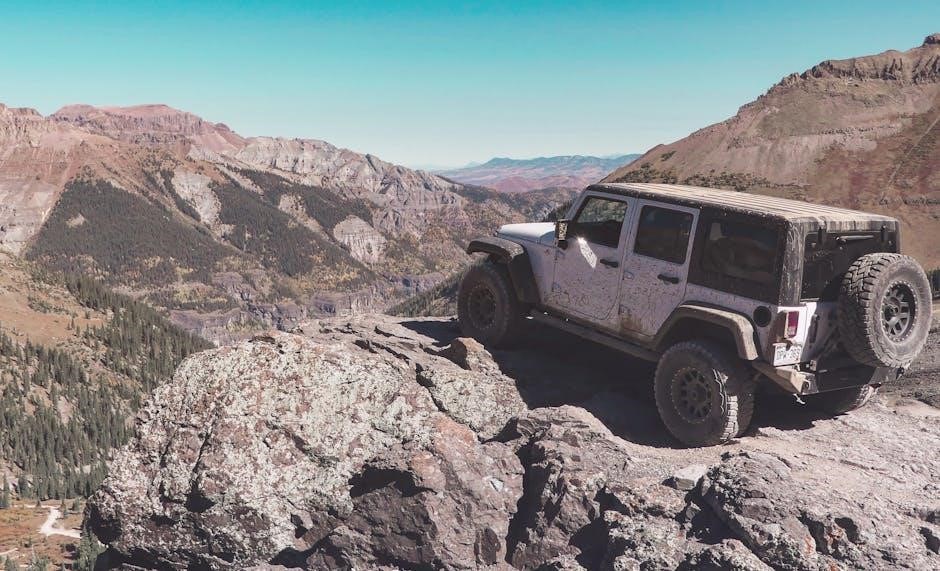
Advanced Features & Technology
Modern Wranglers boast Uconnect systems for infotainment, navigation, and advanced driver assistance. Manuals detail Uconnect operation, updates, and troubleshooting for a connected driving experience.
Uconnect System: Operation and Troubleshooting
The Uconnect system is your Wrangler’s central hub for entertainment, navigation, and vehicle settings. Understanding its interface – touchscreen controls, voice commands, and physical buttons – is crucial for seamless operation. This section details pairing smartphones, accessing Apple CarPlay/Android Auto, and utilizing Bluetooth connectivity.
Troubleshooting common issues like screen freezes, audio problems, or navigation errors is also covered. Learn how to perform a system reset, update software, and diagnose connectivity problems. Refer to the manual for specific error codes and solutions, ensuring a smooth and enjoyable in-vehicle experience.
Navigation System: Updates and Usage
Your Wrangler’s navigation system provides turn-by-turn directions, points of interest, and real-time traffic updates. This section explains how to input destinations, customize route preferences, and utilize advanced features like lane guidance. Understanding map display options and voice guidance settings enhances usability;
Regular map updates are essential for accurate navigation; learn how to download and install the latest maps via USB or Wi-Fi. Troubleshooting tips address common issues like GPS signal loss or incorrect routing. Refer to the Uconnect manual for detailed instructions and support resources.
Understanding the Wrangler’s Towing Capacity
Proper towing is crucial for safe operation. This section details your Wrangler’s maximum towing capacity, which varies based on engine, drivetrain, and axle ratio. Consult the vehicle’s towing guide located within this manual for specific figures. Always adhere to these limits to prevent damage and maintain vehicle control.
Learn about weight distribution, hitch selection, and trailer brake requirements. Properly securing the load and utilizing appropriate safety chains are essential. Ignoring towing guidelines can lead to accidents and void your warranty.
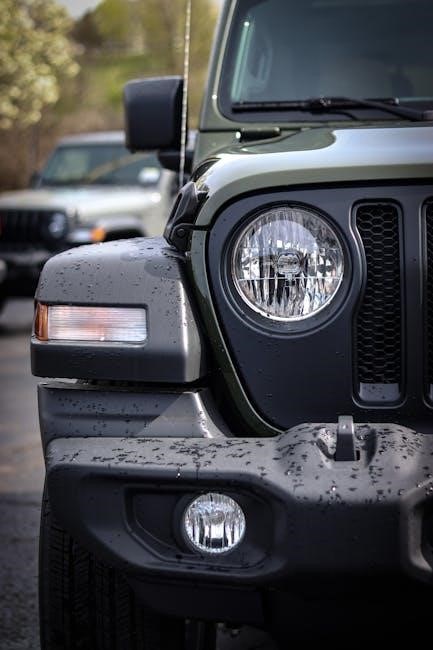
Repair and Service Information
Accessing diagnostic codes (DTCs) and locating repair manuals, like those from autoinfo24.ru and krutilvertel.com, are vital for addressing common Wrangler issues efficiently.
Accessing Diagnostic Trouble Codes (DTCs)
Modern Jeep Wranglers utilize an onboard diagnostic (OBD) system to monitor various components. When a fault is detected, the system stores a Diagnostic Trouble Code (DTC). Accessing these codes typically requires an OBD-II scanner, readily available for purchase or at many auto parts stores.
Connecting the scanner to the vehicle’s diagnostic port, usually located under the dashboard, allows retrieval of stored codes. Resources like repair manuals (found on sites like autoinfo24.ru and krutilvertel.com) provide detailed interpretations of these codes, aiding in pinpointing the source of the problem and facilitating effective repairs.
Understanding DTCs is crucial for accurate diagnosis and avoiding unnecessary component replacement.
Locating Repair Manuals and Online Resources
Finding reliable repair information for your Jeep Wrangler is essential for maintenance and repairs. Several online resources and printed manuals are available. Websites like autoinfo24.ru and krutilvertel.com offer downloadable repair manuals, often specific to model years (e.g., 2006-2010).
Additionally, Jeep enthusiast forums and online communities provide valuable troubleshooting tips and shared experiences. Printed repair manuals, such as those from Motorist, offer detailed diagrams and step-by-step instructions. Always verify the manual’s compatibility with your Wrangler’s specific year and configuration.
Common Wrangler Repair Issues and Solutions
Jeep Wranglers, while robust, can experience common issues. Repair manuals from sources like autoinfo24.ru and krutilvertel.com detail solutions for these. Typical problems include issues with the cooling system, electrical components, and suspension. Regular maintenance, as outlined in the instruction manual, can prevent many failures.
Online forums offer insights into frequently encountered problems and DIY fixes. Accessing diagnostic trouble codes (DTCs), detailed elsewhere, aids in pinpointing issues. Consulting a qualified mechanic is recommended for complex repairs.
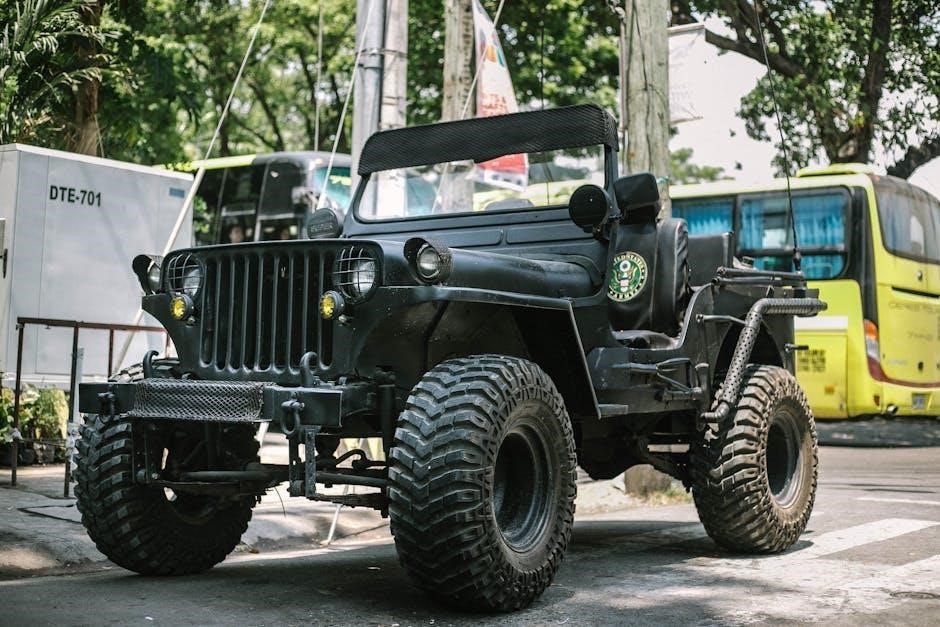
Warranty Information
Your Jeep Wrangler is covered by a manufacturer’s warranty; the instruction manual details coverage specifics, claim procedures, and limitations for peace of mind.
Understanding Your Jeep Wrangler Warranty
The Jeep Wrangler warranty provides coverage for defects in materials and workmanship, offering owners assurance and protection. This instruction manual outlines the specific terms, durations, and exclusions of your vehicle’s warranty coverage.
Key aspects include the basic warranty, powertrain warranty, and corrosion coverage, each with varying timeframes and mileage limits. Understanding these details is crucial for maximizing your warranty benefits. The manual also explains what repairs are covered, and those that are not, along with the process for submitting a warranty claim.
Proper maintenance, as outlined in the manual, is essential for maintaining warranty validity. Failing to adhere to the recommended service schedule may void coverage. Reviewing the warranty information thoroughly ensures you are aware of your rights and responsibilities.
Warranty Claim Procedures
To initiate a warranty claim for your Jeep Wrangler, refer to the detailed procedures outlined in this instruction manual. First, schedule an appointment with an authorized Jeep dealership service center. Clearly describe the issue to the service advisor and present your vehicle’s warranty information.
The dealership will diagnose the problem and determine if it’s covered under warranty. If approved, they will submit the claim to Jeep for authorization. Keep all documentation, including repair orders and invoices, for your records. Promptly address any requests for additional information from Jeep.
Understanding the claim process, as detailed in the manual, ensures a smooth and efficient resolution. Contact Jeep Customer Service if you encounter any difficulties or have questions regarding your claim.
Index & Contact Information
This section provides an alphabetical index for quick topic location and essential Jeep Customer Service contact details. Find resources and support for your Wrangler easily.
Utilize this information for efficient troubleshooting and warranty assistance.
Alphabetical Index of Topics
A – Airbag System, Air Filter Replacement
B – Battery Maintenance, Brake System
C – Cooling System, Coolant Level Checks
D – Dashboard Symbols, Diagnostic Trouble Codes (DTCs)
E – Electrical System, Engine Compartment
F – Four-Wheel Drive, Fluid Level Checks, Fuses
J – Jump Starting
K – Key Components
M – Maintenance Schedule
O – Oil Change Intervals, Operating Instructions
R – Removable Top, Repair Manuals
S – Safety Features, Seatbelt System, Suspension System
T – Tire Maintenance, Transmission Operation, Troubleshooting
V – Vehicle Identification Number (VIN)
W – Warranty Information, Windshield Operation
This index facilitates quick access to specific information within the Jeep Wrangler instruction manual, streamlining maintenance and repair processes.
Jeep Customer Service Contact Information
For immediate assistance with your Jeep Wrangler, please utilize the official Jeep customer service channels. While specific details aren’t provided in the referenced materials, accessing support is crucial for warranty claims and complex issues.
Website: Visit the official Jeep website (jeep.com) for FAQs, owner resources, and online chat support. Phone: Contact Jeep Customer Care at 1-800-992-1945. Mail: Jeep Customer Care, P.O. Box 389, Auburn Hills, MI 48326-389.
Having your VIN readily available will expedite the support process. Refer to your instruction manual for detailed warranty information and claim procedures.